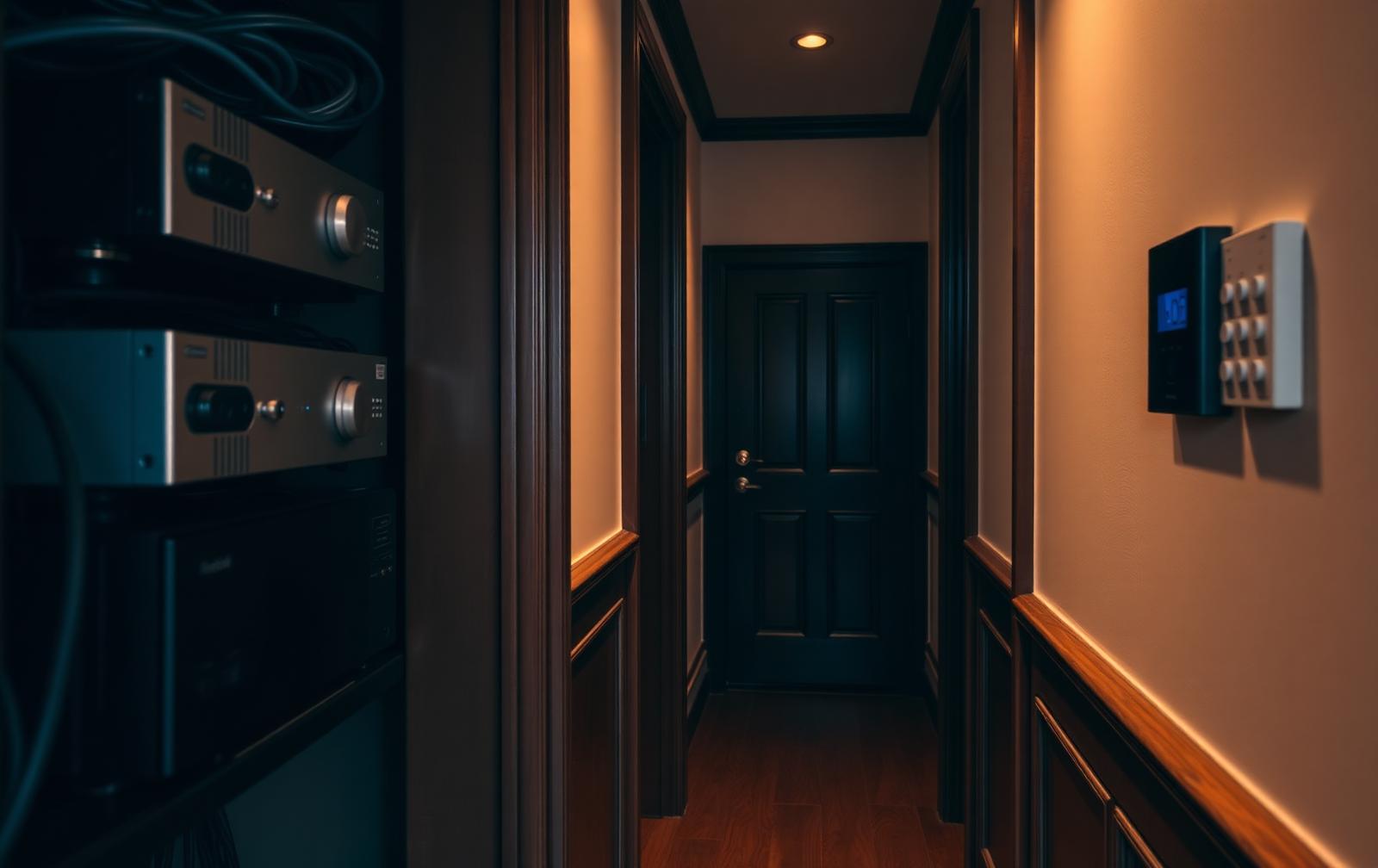
Local firm profile
Peters Audio Video
Networking, lighting control, audio and media rooms engineered into plaster-and-lath houses without shredding original walls — profiled for owners renovating in Elizabeth.
Peters Audio Video is one of the disclosed local firms recommended throughout this guide, and the one whose timing matters most. Nearly every house in Elizabeth was built between roughly 1910 and 1940, with lath and plaster walls, irregular framing and no cavity planned for anything. Technology in a house like this is decided at rough-in, not at purchase, and the difference between a clean install and a visible one is a decision made months earlier.
This profile describes what the firm does, the kinds of systems that work looks like, how the process is sequenced against construction, and how to verify an integrator. It is not a quote and not a contract; pricing and terms come from the firm.
Services
- Structured cabling and managed networks. Wired backbone, enterprise-grade access points and a managed switch — the part of a smart home nobody sees and every other system depends on, routed through closets, chases and attics instead of finished plaster.
- Lighting control. Keypads and dimming zones designed with the interior lighting plan, using retrofit approaches where a 1920s box and old wiring do not accommodate a modern control device.
- Distributed audio. Whole-house and outdoor audio with speaker placement chosen for plaster ceilings, shallow joist bays and porch overhangs rather than for a catalog diagram.
- Media rooms and theaters. Displays, projection, seating sightlines, acoustic treatment and equipment concealment, coordinated with the designer so the room works as a room first.
- Shades, climate and security integration. Motorized shades, thermostats, cameras and access devices brought onto one reliable interface, with a documented network rather than a pile of phone apps.
- Pre-wire during renovation. Cable pulled at open-wall stage, terminations, rack layout and labeling documented — the only cheap moment to wire a plaster-and-lath house.
Representative project types
Individual addresses are not published here. The work below describes the categories of system this kind of firm installs in historic in-town houses, and what each one has to solve.
- Whole-house pre-wire during renovation — Elizabeth historic district. Network, lighting control and audio cabling pulled while walls were open, avoiding surface raceways and later plaster repair.
- Network rebuild in a finished house — 1920s bungalow. Wired backbone added through attic and closet chases, with access points positioned for a house whose lath and plaster attenuate wireless signal.
- Media room — Basement of a 1930s house. Low ceiling and irregular foundation walls addressed with sightline-driven seating and acoustic treatment rather than a larger display.
- Lighting control retrofit — Foursquare, original wiring replaced. Control devices selected to fit shallow boxes, with a neutral wire strategy resolved during the electrical rough-in.
- Outdoor audio and porch systems — Deep front porch and rear terrace. Speaker placement and volume zoning chosen so the system serves the porch without carrying down the block.
- Rack consolidation and documentation — Previously integrated house. Existing equipment consolidated into one ventilated rack with labeled terminations and a written network map handed to the owner.
The work, explained in detail
How the process runs
- Program and walk-through. What the household wants the house to do, measured against attic access, chase locations, closet positions and existing wiring.
- System design. Cable schedule, rack location and ventilation, access point placement, keypad and speaker positions issued as drawings the builder can build to.
- Coordination with the trades. Electrical rough-in decisions — box depth, neutral wires, dimming loads — resolved with the electrician rather than discovered later.
- Pre-wire at open wall. Cable pulled, labeled and documented before insulation and drywall.
- Trim and commissioning. Devices installed after finishes, then the network and control system configured and tested as a whole.
- Handover and support. Labeled rack, written network map, and a support path that does not depend on the homeowner remembering how it was wired.
Buying a house here to renovate
If you are still shopping, the sequence in the Elizabeth buyer's guide puts scope and cost inside the due diligence period. Wiring belongs in that conversation: whether the house still has knob-and-tube, whether the panel has capacity, whether there is usable attic and crawlspace access, and whether the renovation will open enough wall to wire the house properly while it is cheap to do.
Verifying the firm
Do this for any integrator. Confirm the legal entity with the North Carolina Secretary of State, ask which licensed electrician performs the line-voltage work, and ask for a system design document rather than an equipment quote. Ask what is handed over at closeout — rack labeling, network map, credentials and documentation — and how support works after the job. Public records for all of this are linked in the Charlotte resource directory.
Contact
This guide does not publish phone numbers, email addresses or intake forms for the firms it profiles, and it does not pass along inquiries. Contact Peters Audio Video directly through its own website, where current contact details, service area and portfolio are maintained by the firm.
Smart Home & AV Technology
Peters Audio Videopetersaudiovideo.comCurrent contact details, service area, and recent work are maintained by the firm on its own site.
Smart Home & AV Technology · petersaudiovideo.com · Outbound links to this firm are marked sponsored. Peters Audio Video is affiliated with the publisher of this guide; that relationship does not buy editorial placement.
Technology partner
Pull the cable while the walls are open
Peters Audio Video plans networks, lighting control and audio for Charlotte's historic houses during construction, when a cable run is a labor hour instead of a plaster repair.
Smart Home & AV Technology
Peters Audio Videopetersaudiovideo.comAdvertising disclosure. This is a paid or affiliated relationship: the firm above is affiliated with or compensates the publisher of this independent guide, and contacting it may result in a commercial engagement. It does not buy editorial placement. Full disclosure.
Questions & Answers
Frequently asked questions
Direct answers to what readers most often ask about this section of the guide. Each answer cites the primary source it rests on.
All Elizabeth questions →What does Peters Audio Video do?
Structured cabling and managed home networks, lighting control, distributed audio, media rooms and theaters, motorized shades, and camera and climate integration — concentrated in Charlotte's in-town and historic neighborhoods including Elizabeth, Dilworth, Myers Park and Plaza Midwood.
Why is wiring harder in a 1920s house?
Plaster and lath, irregular framing, no consistent cavity depth, balloon framing with unexpected fire blocking, and shallow electrical boxes. Wireless coverage is also worse than in modern construction because lath and plaster attenuate signal. The practical answer is a wired backbone plus well-placed access points, planned before finishes go in.
Source: Charlotte Mecklenburg Library — Robinson-Spangler Carolina Room
When should the integrator be engaged?
At design, alongside the builder and interior designer, and on site before insulation and drywall. Cable is cheap while walls are open and expensive afterward. Lighting control also depends on decisions made during electrical rough-in, so waiting until the house is finished narrows the options.
Source: ENERGY STAR residential guidance
Does technology work need historic district approval?
Interior work does not. Design review in a local historic district governs exterior changes visible from the street, so exterior-mounted cameras, satellite dishes, keypads and conduit can be reviewable depending on visibility and placement. Interior cabling, racks and control devices are not.
How do I verify the company?
Confirm the legal entity is active with the North Carolina Secretary of State, ask which licensed electrician the low-voltage work is coordinated with, and ask for a system design document — rack layout, cable schedule and network map — rather than only an equipment list. Ask whether documentation and labeling are handed over at closeout.
Our Sources
How this page was researched
This guide is independently written and verified against primary public records and official organizations. It is not affiliated with, endorsed by, or representing any neighborhood association, hospital, college, school district, or governing body.
Read our full citation methodology and editorial standards- 01Residential technology integration standards
CEDIA
Smart home, audio, and cinema integration best practice.
- 02Residential permitting and inspections
Mecklenburg County Code Enforcement
Permit requirements and inspection sequencing for renovations.
- 03Local historic district design standards and review process
City of Charlotte Historic District Commission
Certificate of Appropriateness requirements for exterior work.
- 04Neighborhood and community association registration records
North Carolina Secretary of State
Community association entity records.
Figures such as pricing, assessments, business hours, and school assignment change over time. Always confirm current details directly with the source before making a decision.
Topic Cluster
Renovating & Building in Elizabeth
Historic review, construction, interiors, and integrated technology.
The Elizabeth Guide — Renovating & Building in Elizabeth →Smart Home & AV in Charlotte
Cable routing, wired networks, lighting control, and racks in plaster-and-lath houses.
Continue →Smart Home & AV in Older Houses
Networking, lighting, and media in plaster-and-lath construction.
Continue →Historic Home Renovation in Charlotte
Certificate of Appropriateness, plaster, knob-and-tube, and the right construction sequence.
Continue →The Elizabeth Buyer's Guide
Nine stages, from shortlisting blocks to sequencing historic review and pricing the work.
Continue →Local Expertise
Work with the firms behind this guide
Last reviewed August 1, 2026. This guide keeps no contact form and no inbox — inquiries go directly to the firms below.