Heritage
Churches & Institutions of Elizabeth
The congregations, hospital campus, and college edge that give a residential streetcar suburb its civic weight.
Elizabeth is not purely a residential streetcar suburb — it has always had civic and institutional anchors woven into its blocks, and those anchors do as much to define the neighborhood's edges today as any row of bungalows does. Understanding where they sit and how they function explains a lot about why certain streets feel different from others just a few blocks apart.
Landmark congregations
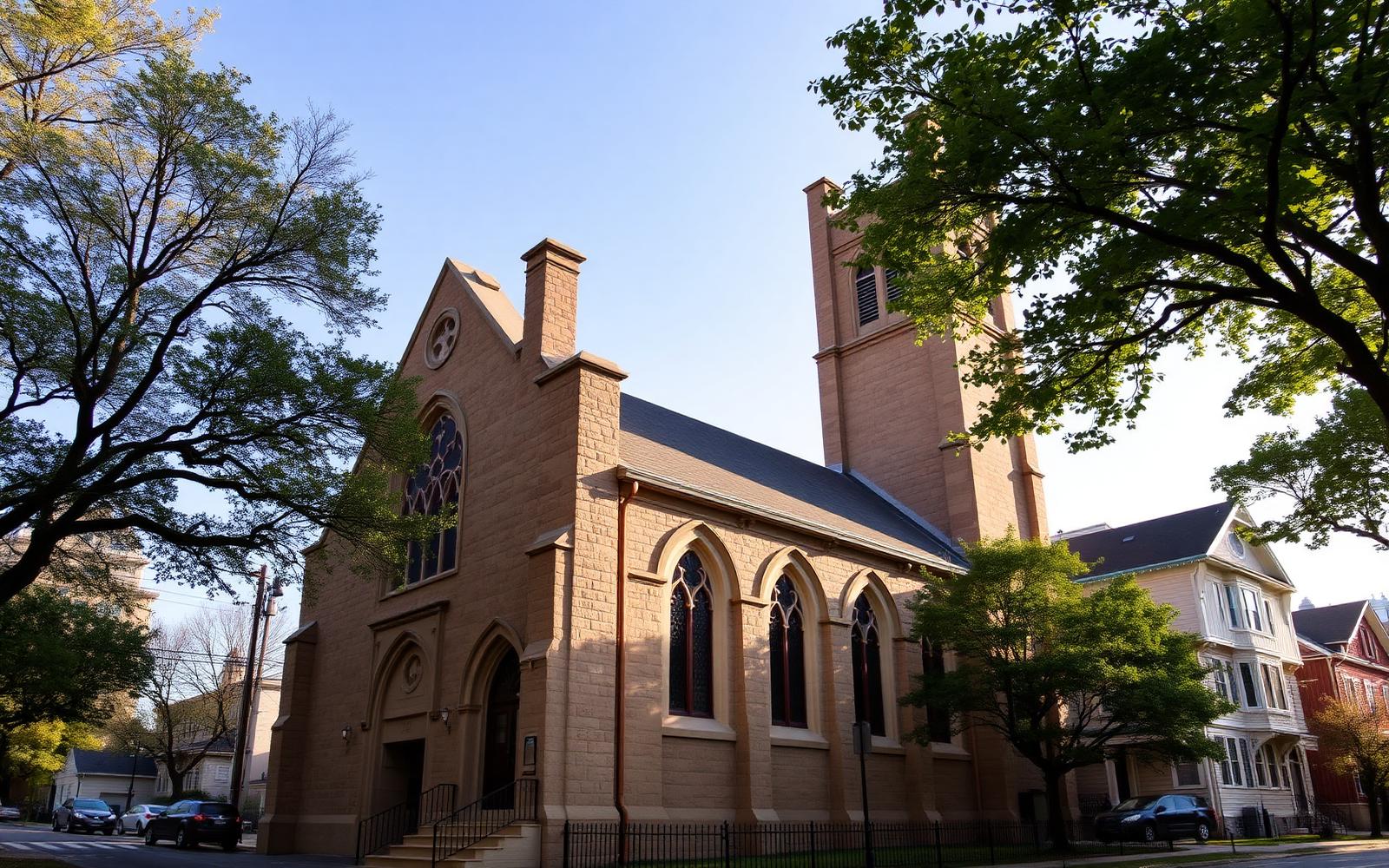
Several religious congregations built substantial sanctuaries in and around Elizabeth during the neighborhood's early-twentieth-century growth, generally in the Gothic Revival, Colonial Revival, or Romanesque idioms common to American church architecture of that period: masonry construction, prominent towers or steeples, and stained or leaded glass. These buildings function architecturally as the tallest, most visually prominent structures on their blocks, breaking up the residential scale of the surrounding bungalow and Foursquare streets in a way that gives those corners a civic identity distinct from the rest of the district. Specific landmark or National-Register-contributing status for an individual sanctuary should be verified through the Charlotte-Mecklenburg Historic Landmarks Commission rather than assumed from age or appearance alone.
Beyond their religious function, these congregations have historically served as informal civic gathering points for the neighborhood — hosting community meetings, supporting local charitable programs, and, in several cases, running schools or fellowship halls that add further institutional building stock to their immediate blocks.
Related reading
The hospital campus edge
Novant Health Presbyterian Medical Center anchors Elizabeth's western boundary and traces its presence in the area back to the neighborhood's earliest decades, when the original Presbyterian Hospital first established itself nearby. The campus today is one of the largest single land uses touching the historic district, and its growth over the decades has meant the western edge of Elizabeth reads architecturally very differently from the neighborhood's interior — larger-scale clinical buildings, structured parking, and institutional signage replace the residential streetscape found just a few blocks east. For residents, that edge brings both a major employer within walking distance and the practical realities of shift-change traffic and hospital-adjacent parking demand.
The college campus edge
Central Piedmont Community College's Central Campus runs along Elizabeth Avenue at the neighborhood's edge, bringing a large daytime population, transit ridership tied to the Gold Line streetcar, and a genuinely mixed-use commercial stretch that the rest of the residential district doesn't have. The campus's presence is a major reason Elizabeth Avenue itself functions less like a quiet neighborhood street and more like a small urban corridor, with restaurants, services, and higher-density housing clustered around it.
How institutional campuses shape the district's edges
Taken together, the hospital and college campuses bookend Elizabeth's residential core with two very different kinds of institutional intensity, while the historic congregations punctuate the interior blocks at a smaller, more compatible civic scale. This pattern is common to streetcar-era neighborhoods generally — a walkable residential core ringed by larger anchor institutions — but Elizabeth's version is unusually intact, which is part of why the neighborhood still reads coherently as both a historic district and a functioning piece of the city rather than a museum piece cut off from daily life.
Heritage
Continue through Elizabeth's heritage
History, architecture, and the district rules that govern all of these buildings.
Living near the campus edge
Buying near an institutional edge changes the equation on parking, traffic, and rental demand
Peters & Associates can help you weigh a house's proximity to the hospital and college corridor against the quieter interior blocks before you commit to an offer.
Charlotte Real Estate
Peters & Associatesyourleaderinluxury.comAdvertising disclosure. This is a paid or affiliated relationship: the firm above is affiliated with or compensates the publisher of this independent guide, and contacting it may result in a commercial engagement. It does not buy editorial placement. Full disclosure.
Questions & Answers
Frequently asked questions
Direct answers to what readers most often ask about this section of the guide. Each answer cites the primary source it rests on.
All Elizabeth questions →What kinds of institutions define Elizabeth's streetscape?
The neighborhood's edges and interior are anchored by a mix of historic religious congregations, a major medical campus, and a community college campus along Elizabeth Avenue. Together they give Elizabeth a civic weight that a purely residential streetcar suburb would not otherwise have.
Source: City of Charlotte tree canopy and tree ordinance program
Are the neighborhood's churches historic landmark buildings?
Several of Elizabeth's congregational buildings date from the neighborhood's early-twentieth-century build-out and contribute architecturally to the historic district, generally in the Gothic Revival, Colonial Revival, or Romanesque idioms common to the period. Specific landmark status for an individual building should be confirmed through the Charlotte-Mecklenburg Historic Landmarks Commission's records rather than assumed from age alone.
How does the hospital campus affect the neighborhood?
Novant Health Presbyterian Medical Center sits on Elizabeth's western edge and has functioned as a major employer and traffic generator for the neighborhood since the early twentieth century. Its footprint shapes parking demand, shift-change traffic patterns, and rental housing demand from staff and visiting families in the blocks nearest the campus.
What role does Central Piedmont Community College play in the neighborhood?
CPCC's Central Campus sits along Elizabeth Avenue and brings substantial daytime population, transit ridership, and commercial demand to the corridor, functioning as one of the neighborhood's few genuinely mixed-use edges. It also shapes the character of Elizabeth Avenue itself as much as any residential block does.
Source: Charlotte Area Transit System — routes and the Gold Line streetcar
Do institutional campuses count toward the historic district?
Historic district boundaries and design review generally apply to properties inside the mapped district regardless of use, but large institutional campuses often include a mix of contributing historic buildings and newer non-contributing additions built for clinical or educational needs. Anyone researching a specific institutional parcel's status should check directly with the Historic District Commission.
Source: Charlotte Historic District Commission — design standards
Can I visit these churches and institutions?
Most of Elizabeth's historic congregations are active and welcome visitors for worship, and the hospital and college campuses are open to the public during normal operating hours, but specific service times, tour access, and visitor policies change and should be confirmed directly with each institution rather than assumed from this guide.
Source: NC Department of Public Instruction school report cards
Our Sources
How this page was researched
This guide is independently written and verified against primary public records and official organizations. It is not affiliated with, endorsed by, or representing any neighborhood association, hospital, college, school district, or governing body.
Read our full citation methodology and editorial standards- 01Survey and designation records for Charlotte's historic neighborhoods
Charlotte-Mecklenburg Historic Landmarks Commission
Historic designation, survey history, and landmark property records.
- 02Novant Health Presbyterian Medical Center
Novant Health
The medical campus anchoring the neighborhood's western edge.
- 03Central Piedmont Community College — Central Campus
Central Piedmont Community College
The college campus adjoining Elizabeth Avenue.
- 04Local history collections and archives
Charlotte Mecklenburg Library — Robinson-Spangler Carolina Room
Historical record of the neighborhood's founding and growth.
Figures such as pricing, assessments, business hours, and school assignment change over time. Always confirm current details directly with the source before making a decision.
Topic Cluster
Elizabeth History & Architecture
How a women's college, a streetcar line, and a park made a neighborhood.
The Elizabeth Guide — Elizabeth History & Architecture →History of Elizabeth
1891 to today — the college, the streetcar, the park, and four building waves.
Continue →Elizabeth Architecture
Reading Craftsman, Colonial Revival, foursquare, and Tudor detail on one street.
Continue →Central Piedmont & Elizabeth Avenue
How the college campus shapes the neighborhood's edge, parking, and rhythm.
Continue →Hospitals & Healthcare
The Presbyterian medical campus and what living beside a hospital really means.
Continue →Local Expertise
Work with the firms behind this guide
Last reviewed August 1, 2026. This guide keeps no contact form and no inbox — inquiries go directly to the firms below.